
calls for articles: colour
call for articles, proposals due December 1, 2026
colour in architecture, landscape, infrastructure, materials.
calls for articles
on site review 50:: colour
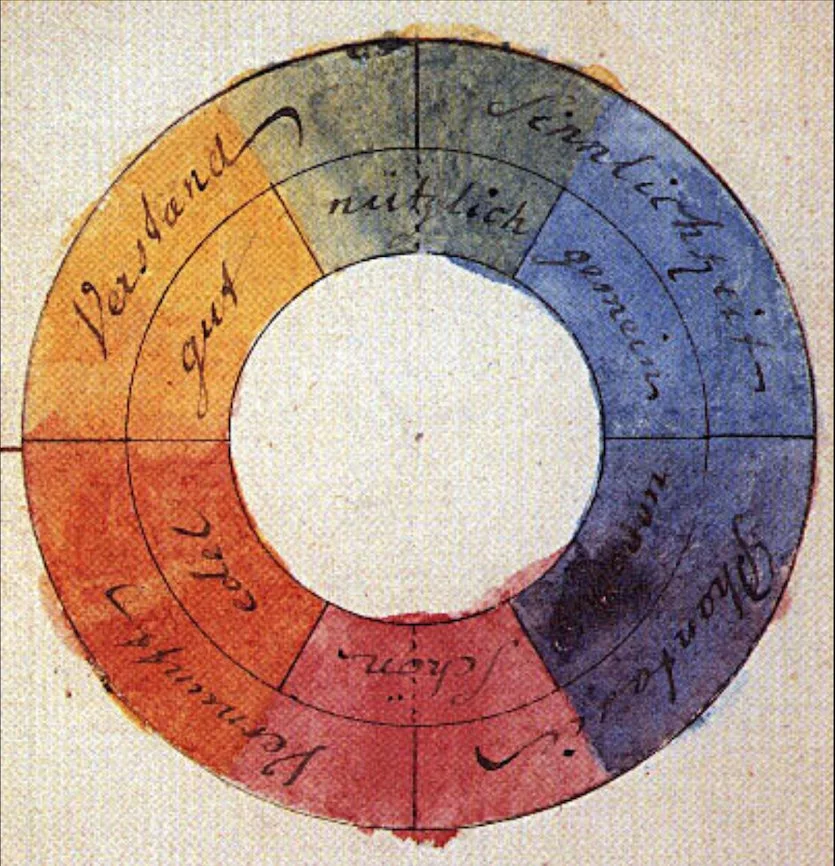
Not just a significant poet, Geothe also devised a colour theory, in 1810. One can lose oneself in wikipedia’s page of colour theory.
For On Site review 50 (fifty!) we would like to look at colour in architecture, landscape, cities, infrastructure; in the streets, in paintings, in light, in weather — in the material conditions of our discipline.
Colour has history, theory, surfaces and depths of tints and hues, geological strata where minerals colour the sands, the waters. Life is not all dolourous grey, although aerial bombing does remove colour completely from places once rich with colour and life.
There are synthetics: the pthalo green of printers’ ink, and naturals: as I write this, a small green bird lands on the honeysuckle outside the door — instantly indistinguishable from a leaf. And then there is camouflage: wildly coloured jagged shapes once painted on warships: not invisibility but total confusion of colour and mark that sets surface away from object. And there was colour-field painting. Why did it occur when it did, in the 1950s, and not some other time. And this is where it starts to be interesting: how does colour manage our perceptions of surface and space?
And what about non-colours? Must everything ‘smart’ these days be shades of tan and grey? Other cultures have used colour with more gaiety than we currently do. Although there are more significant aspects to our environment such as resilience, economy and honesty, often it is colour that hits our eye first: unfair, but colour is often a signal, a cultural mark that stands for something.
Everyone will have a line into this subject; it is at once personal and universal. How have you seen it play out in our built environment? How do you use it in your work? Do you rely on the integral colour of materials, or are these just a base for a bolder intervention?
Was there a historical era, or is there a present day world where colour is unfettered?
Is colour merely decorative? or is it something that is deeply human.
We would like proposals for articles, essays, photo-essays, prose and poetry, drawings and ideas for On Site review 50 by December 1, 2026. Please outline your subject, how you might treat it, illustrate it and format it. There is a page of specifications here: https://www.onsitereview.ca/specs for proposals and final submissions; do read it, as it gives a direction to how you might think about a submission to On Site review.
Accepted proposals then have 6 weeks to be worked up into full submissions which takes you up to January 15, 2027.
For proposals, please use the contact-us form: https://www.onsitereview.ca/contact-us
This form does not take images. Its purpose is for you to send a description of what you would like to eventually submit. We receive this contact-us message, reply by email, and from then on conduct our correspondence through email, which does take attachments.
Please feel free to forward this call for articles (https://onsitereview.ca/callforarts) to anyone you think might be interested, or who you know is working in this area, or who has in the past considered this topic, or done projects related to it. We rely on your contacts as well as own, and always welcome new voices.